Saturday, September 14, 2013

BASICS OF STATISTICS for ADVANCED ALGEBRA STUDENTS

Some of the concepts in your first Statistics test are already part of your mathematical skill set.  You already know, for example, how to calculate average or mean, median, and mode.  These are measures of central tendency.  They tell typical values like (respectively) the score that everyone would have gotten on that test if all points earned had been evenly distributed among the students, the middle of the scores where half of the students got a higher grade and half a lower one, or the most frequent score received.

You probably understand the concept of range - the spread between two values, the difference between the highest score on a test and the lowest.  You may even have drawn box and whiskers diagrams and frequency graphs as long ago as elementary school.

In higher level Algebra courses, we add a few details to make statistical measures and displays even more useful.

Some useful SYMBOLS

 (Pronounced "mew") This Greek letter stands for the POPULATION MEAN.


 (Called "ex bar")  This symbol represents the SAMPLE MEAN.


(Small sigma from the Greek alphabet)  Sigma is the symbol for for POPULATION STANDARD DEVIATION.

The small ess is used to signify the SAMPLE POPULATION STANDARD DEVIATION.


Using the MEDIAN

Median is used to construct a BOX and WHISKERS PLOT.

The middlemost element in a collection tells us where 50% of the subjects or items are higher and 50% lower.  The middle element (median) of the lower half and the middle element (median) of the upper half are the first and third quartiles (Q1 and Q3).


Quartiles divide the data into quarters, so at Q1, 1/4 of the scores are lower, while at Q3, 1/4 are higher.  The difference between Q1 and Q3 is the interquartile range, IQR.  It describes the location of the middle 50% of items in the group and is less influenced by extreme values than some other measures.  In fact, we use the IQR to determine whether values are too far from the central tendency to be worthy of consideration.

Say we want to know how many students are likely to attend the basketball game this weekend.  We’ve kept count of the number of attendees at the past 15 games and the interquartile range is 100.  But last month, there was one game that was attended by 700 fans!  That statistic is  so high, it could throw off measures of central tendency like the mean, so how do we tell for sure if we should count it as the highest value element or something else?

Identifying OUTLIERS

Using the IQR, we can calculate the limits beyond which certain values are too extreme to be of importance.  We call these outliers.

The limit of “reasonable” element values is 1.5 times the IQR either above Q3 or below Q1.

In our basketball game example, we can arbitrarily say that 100 is our mean.  the reasonable upper limit would be 1.5 X 100, or 150 above the Q3 count of 200 (another arbitrary example for demonstration sake), or 350 fans.  That 700 game was definitely an outlier.


On the box and whiskers plot, outliers are marked, maybe by an X but OUTSIDE the whiskers.


The measures forming the box plot (excluding any outliers) are sometimes called the “5 Number Summary.”

Using the MEAN

We’ve been calculating the arithmetic mean (average) since grammar school.  Almost every 5th grader will tell you that to figure out the average, “add ’um all up and divide by the number of ‘um.”  The use of the mean in statistics is yet another example of my guiding principle: you learned everything there is to know in math before you entered middle school.  From then on, we just use those things in new ways. 

So let’s use the mean to figure out how things are distributed around that central tendancy.  Let’s first calculate the VARIANCE by finding the distance of each value from the mean...


 then squaring it to remove the implication of more than or less than the average...


Now divide by the number of items and we have an average of the squares...


In these equations, I've used the symbols for SAMPLE MEAN.  To calculate the POPULATION MEAN, use mu.  Some texts distinguish the Sample Mean from the Population Mean by using n-1 as the denominator in the former.  I've never made that distinction, but check with your text to see what your class requires.

Either Variance equation used gives us a measure of how spread out the items are, but squaring the differences has provided a number that isn’t the same “weight” as the individual items.  To find the STANDARD DEVIATION, we need to undue those squares...

Use this equation for standard deviation when you are able to survey every member of the population.  If a smaller sample is used, errors could effect the standard deviation.  Experience has suggested a modest alteration in the equation in order to gain a more reliable result:


Use this equation for standard deviation when you only tested a sample of the entire population.  This minor alteration in the denominator was suggested after statisticians found that it reduces some of the inaccuracy created when a small sample is used to extrapolate to a full population.

Using Standard Deviation with a Normal Bell-shaped Curve

Given a normal curve (that bell-shaped graph that puts the mean in the middle along with median and mode and tapers off at both ends), we can predict that roughly 68% of the values will fall within one standard deviation of the mean, 95% within two standard deviations, and almost every value (99%) within 3 standard deviations.


Are you wondering where the percentages came from?  So did I.  It seems that statisticians for many, many years have collected and analyzed data and actually “discovered” that for things that approach a normal curve (like heights of adult males) the 68-95-99 standards are the areas under the curve at points very close to 1-2-3 standard deviations from the mean.  I’m just taking their word for it because I am not willing to do as much arithmetic as it would take to verify the data.  I’m accepting the percents as a postulate.


Using a Z score

When I want to compare two different surveys, like a student’s results on two separate Math tests, it would be handy to have a single measure of comparison.  Here’s where the Z-score comes in handy.  It tells how each score deviates from the mean of that particular test.

A Z-score of -1 is one standard deviation below the mean, while +2 means the grade was 2 standard deviations above.  To calculate the Z-score, find the difference between the score and the mean, and divide by the standard deviation...

These 5 equations are probably more than will be covered in the first Statistics test.  Much of what comes later in the course also relies on equations, so I suggest that you start a note card now, before too much information gets out of control.  


Coming up, we’ll look at correlation coefficient, confidence intervals, and probability indexes.  Go figure!


Wednesday, September 4, 2013

PARTIAL FRACTIONS (Revisited)

WHY DO WE STUDY PARTIAL FRACTIONS IN ALGEBRA AND PRECALCULUS?

This one is for Emma.  A "strange" question appeared on her Precalc review worksheet.  It didn't appear to be related to the transformation of graphs concept that was the focus of the homework.  The problem looked something like this:
         Solve for A and B:                    x             =       A    +    B   
                                       x^2 + 3x + 2      (x + 1)  (x + 2)       I wondered how many of the students didn't even know that this is a partial fractions question.  This is an honors class, but I don't recall the topic being covered in previous courses.  For the benefit of everyone in the class, here's the lesson we shared in our tutorial session.  (It's a repeat of the blog entry from June, 2013)

In the early days of Algebra study, we covered “collect like terms” so that the process would be a simple step once we got to FOIL (also called “double distributive” in some schools).  The same thinking encourages us to learn other basic algebraic steps before using them in more complicated mathematics.  In Calculus, we may need to decompose rational expressions before applying the rules of integration.  By doing the initial algebraic work of decomposition now, higher level concepts will be easier to learn and understand.

There are several situations which may be presented in Partial Fraction exercises.  We’ll start with the simple and work toward the more complex.

Simple rational expression:

               2x + 3       
          (x^2 - 7x +10)        Notice that the degree of the numerator is smaller than the degree of the denominator.  This is an important restriction that must be met.  (see below: “What if the Numerator is a higher degree than the Denominator?”)

    STEP 1 - factor the denominator

              2x + 3  
            (x-2)(x-5)

    STEP 2 - using the factors from the denominator, list separate fractions to form an equation. (We don’t know the numerators yet, so let’s just keep them blank until Step 3).

              2x + 3        ?          ?  
            (x-2)(x-5)= (x-2) + (x-5)

    STEP 3 - Substitute letters for the unknown numerators.

              2x + 3         A          B 
            (x-2)(x-5) = (x-2) + (x-5)

    STEP 4 - Expand the right side to have a common denominator.

              2x + 3        A(x-5) + B(x-2)
            (x-2)(x-5) =   (x-2)      (x-5)

    STEP 5 - Since denominators on both sides of the equation are the same, set the numerators equal and distribute A and B.
   
              2x + 3    =  Ax - A5 + Bx - 2B

    STEP 6 - Collect like variable terms.

              2x + 3   = (A + B)x - 5A - 2B

    STEP 7 - Create a system of equations by setting coefficients of the variables equal.

            2  = A + B
            3  = -5A -2B            The reason I prefer this ‘systems’ method to some others is that I can use the matrix function on my calculator to get answers with only a few key strokes and no manual arithmetic.
    STEP 8 - Solve the system.

            A = -7/3
            B = 13/3

    STEP 9 - Seems like a lot of steps so far, but this is the last one.  Substitute A and B values into the equation from Step 3.

              2x + 3         -7/3      13/3 
            (x-2)(x-5) =  (x-2) +   (x-5)


WHAT ABOUT MORE COMPLEX DENOMINATORS?
             
   
    More factors?  Include more fractions in Step 3....
   
                 2x + 3              A         B         C  
            (x-2)(x-5)(x-1) = (x-2) + (x-5) + (x-1)

    .... and continue with Steps 4 - 9  (SOLUTION:  A = -7/3, B= 13/12, C= 5/4)

    Repeated binomial factors?  Consider the highest degree of the repeated binomial and EVERY SMALLER DEGREE to set up the equation in Step 3....

                2x + 3             A         B           C    
            (x-2)(x-5)^2   = (x-2) + (x-5) + (x-5)^2

    ....and continue with Steps 4 - 9.  (SOLUTION:  A= 7/9, B= -7/9, C=13/3)

A quadratic factor?  If the denominator is quadratic, make the numerator of the fraction a binomial...

          2x + 3             A        Bx + C   
    (x-2)(x^2 - 5)   = (x-2) + (x^2 - 5)

    ....and continue with Steps 4 - 9.  (SOLUTION: A=-7, B=7, C=16)

    What if the Numerator is a higher degree than the Denominator? 
AHA!!  Another example of how simple algebra concepts are eventually used again as steps within more complex algorithms!!  To satisfy the requirement that Partial Fractions can only be constructed if the Numerator is a lower degree than the Denominator, we need to break up the rational expression even more by LONG DIVISION.  The Partial Fraction is constructed from the REMAINDER, expressed as a fraction with the divisor as the Denominator.

Monday, August 19, 2013

VECTORS - What is a UNIT VECTOR?

By vector definition, a UNIT VECTOR is one in which the Magnitude equals 1.  (To review how to calculate Magnitude, refer to thenormalgenius.blogspot.com article "Vectors: What is Magnitude?," published on 8/19/13.) 

In working with vectors, it is sometimes simpler to use, or the equation calls for, a unit vector in standard position, i.e., originating from (0, 0).  Transforming a given vector into a friendly unit vector is easily envisioned by relating it to common algebra and geometry.

Think of a vector as the hypotenuse of a right triangle.  Draw sides parallel to the x axis and y axis.

If you start with a right triangle (5,12,13 for example) you would need to multiply the hypotenuse by its reciprocal (the multiplicative inverse - one of the properties of real numbers) in order to get it back to 1 (the multiplicative identity).  Dividing each of the legs by 13 (the hypotenuse) would give you the coordinates that would create a special right triangle with hypotenuse of 1 (5/13, 12/13, 1).

Try it with any right triangle:

         3,4,5 transformed to a right triangle with hypotenuse of
         length 1 would be   3/5, 4/5, 1.

         x, x√3, 2x gives you sides of length (x / 2x) or 1/2
         and (x√3 / 2x) or √3 / 2.

         These numbers sound a little familiar, don’t they?  I’m thinking Trigonometry -- Sine and Cosine of 30° and 60° angles.  And they coincide with the 30°- 60° - 90° right triangle that has sides equal to our example and the hypotenuse terminating on the circumference of a UNIT circle.


So when the study of vectors comes up and you are asked to determine whether a vector is a UNIT VECTOR, if the magnitude is 1, you know it is.  For scalar or vector components, you will want to change a vector INTO a UNIT VECTOR: divide x and y by the magnitude.  In the not-so-distant future, as part of the study of vectors in Precalculus, you'll discover equations which contain terms that look like this...
and you'll recognize the unit vectors.  A discussion of components will highlight these terms in an upcoming blog article. 


Sunday, August 18, 2013

INDEX - THE NORMAL GENIUS ARTICLES

    CATEGORY   
DATE        TOPIC
----------------------------------------------------------------

    A BLOG INTRODUCTION

  3/19/10     THE NORMAL GENIUS

    ACT

  11/17/10   THE ACT SUGGESTS DEPRESSINGLY LOW BENCHMARKS FOR  COLLEGE READINESS
  7/3/10       4 MISCONCEPTIONS THAT MAY BE LIMITING YOUR ACT SCORE
  3/20/10     ACT LINK
  4/2/10       FOOD FOR THOUGHT (EATING YOUR WAY TO AND THROUGH THE ACT)
  3/29/10    QUICK TIPS FOR THE ACT
  7/27/10    SCHOLARSHIP AWARDS BASED ON YOUR ACT SCORE
  3/31/10    TIPS FOR ACT TEST DAY

    ACT - ENGLISH

  7/22/10    ACT: ENGLISH GRAMMAR
  3/19/10    IMPROVING ACT ENGLISH

    ACT - MATH

  3/24/10    ACT MATH CHECKLIST
  3/20/10    IMPROVING ACT MATH, PART ONE
  3/24/10    IMPROVING ACT MATH, PART 2
  3/22/10    REMEMBERING MATH FORMULAS

    ACT - READING

  3/25/10    IMPROVING ACT READING

    ACT - SCIENCE REASONING

  3/30/10    QUICK REVIEW OF ACT SCIENCE REASONING

    ACT - STUDY PLAN

  4/6/10      ACT - APRIL 10, 2010 (3 DAY STUDY PLAN)
  5/7/10      SELECTING A STUDY PLAN FOR THE ACT
  5/4/10      SOPHOMORES: GETTING READY TO STUDY FOR THE ACT
  3/26/10    START SLOWLY. WORK SMART. DO IT TODAY!
  5/31/11    STUDY FOR FINALS OR THE ACT?

    ALGEBRA

  7/21/13    QUICK STEPS TO COMPLETE THE SQUARE
  7/21/13    QUADRATIC EQUATIONS & THE PARABOLA (ALGEBRA II)
  7/18/10    PRE-SEMESTER REVIEW FOR ALGEBRA - PROPERTIES OF REAL NUMBERS
  2/8/11      LINEAR & ANGULAR VELOCITY

  7/21/13    ALGEBRA II: QUADRATIC EQUATIONS & THE PARABOLA
  7/21/13    QUICK STEPS TO COMPLETE THE SQUARE
  8/6/13      THE SUM OF TWO SQUARES - BREAK THE RULES
  8/6/13      IMAGINARY NUMBERS; TOOLS AND TRICKS  

    AP CALCULUS

  1/7/11      ORGANIZE YOUR RESOURCES (CALCULUS)
  3/31/11    SPECIAL STUDY FOR THE AP CALCULUS AB TEST
  4/27/11    AP CALCULUS AB
  5/1/11      WHAT THE TEACHERS ARE ASKING ABOUT AP CALC AB
  9/11/11    PREPARING FOR CALCULUS

    AP STATISTICS

  8/27/12    GETTING READY FOR AP STATISTICS - LEVELS OF MEASUREMENT
  8/18/12    GETTING READY FOR AP STATISTICS: VOCABULARY BASICS
  8/11/12    GETTING READY FOR AP STATISTICS: MEAN-MEDIAN-MODE
  8/4/12      GETTING READY FOR AP STATISTICS: COMMON GRAPHS


    CHEMISTRY

7/26/13    FIRST STEP IN CHEMISTRY - THE ATOM
8/19/13    BALANCING EQUATIONS

    COLLEGE

8/28/10    EARLY DECISION COLLEGE APPLICATION
10/4/10    PAYING FOR COLLEGE
6/2/11      A SPECTACULAR GPA IS NOT ENOUGH
1/22/12    PLANNING YOUR COLLEGE VISITS
1/9/12      PAYING FOR COLLEGE: SAVING MONEY ON TEXTBOOKS
4/1/10      EARN COLLEGE CREDIT WITH CLEP TESTS
7/25/10    ESSENTIAL STUDY MATERIALS FOR COLLEGE

    ELEMENTARY

1/17/12    TIPS FOR ELEMENTARY SCHOOL PARENTS: SHOULD WE HIRE A TUTOR?
8/9/10      NUMERACY: A FIRST STEP TOWARD PRESCHOOL MATHEMATICIANS

8/2/13      SINGAPORE MATH: USING BAR MODELS
8/9/13      SINGAPORE MATH: PARENTAL INVOLVEMENT
8/11/13    SINGAPORE MATH: AT-HOME RESOURCES


     EXAMS

5/4/10      FINAL EXAMS -- 3 WAYS TO PROCRASTINATE
5/27/10    FINALS - ACT - SUMMER!


    GENERAL MATH

8/8/10    GENERAL MATH    GET READY FOR THE NEXT LEVEL OF MATH

    GEOMETRY

1/4/11      THE AMBIGUOUS CASE (GEOMETRY & TRIG)
7/17/10    PREPARING FOR THE NEXT LEVEL OF MATH: GEOMETRY

    PRECALCULUS

3/30/11    COMPLEX NUMBERS..TO POLAR COORDINATES..TO RECTANGULAR COORDINATES
8/26/12    PARAMETRIC EQUATIONS: MATH ART
6/27/13    PARTIAL FRACTIONS - THE BASICS
6/26/13    VECTORS IN A NUTSHELL

6/27/13    PARTIAL FRACTIONS: the basics
8/19/13    VECTORS: WHAT IS MAGNITUDE
8/20/13    VECTORS: WHAT IS A UNIT VECTOR:

    PSAE

4/25/10    DO YOUR BEST ON THE PSAE
4/13/10    JUNIORS: 2 WEEKS TO THE PSAE STUDY PLAN
3/19/10    PRAIRIE STATE ACHIEVEMENT EXAM
3/31/10    SAMPLE QUESTIONS FOR THE PSAE (PRAIRIE STATE)
4/7/10      SENIORS! PSAE & GRADUATION

    PSAT

8/9/12    GETTING READY FOR THE PSAT

    SAT

2/17/11    TAKING THE SAT?

    STUDY SKILLS

8/22/10     FIRST DAY OF CLASS: COLLECT CONTACT INFORMATION
9/6/10       THE DIFFERENCE BETWEEN LEARNING & STUDYING
9/17/10     USING TESTS & QUIZZES TO MAXIMIZE YOUR STUDY PLAN
12/31/10    WHAT MOTIVATES THIS STUDENT?
1/14/11      TEST STRESS: CHICAOG TRIBUNE ARTICLE
2/18/11      MATH 911
9/13/11      PREPARE TO STUDY FOR SEMESTER FINALS
6/7/12       PAINLESS SUMMER GEEK
7/2/12       DOG DAYS MATH
5/19/10     STAYING MOTIVATED TO STUDY
7/8/10       SUMMER DATE BOOK = PSEUDO ASSIGNMENT PLANNER

    TEST TAKING

5/4/10      FINAL EXAMS -- 3 WAYS TO PROCRASTINATE
5/27/10    FINALS - ACT - SUMMER!
  

    TRIGONOMETRY

6/28/13    TRIG SUM & DIFFERENCE IDENTITIES

VECTORS: WHAT IS MAGNITUDE?


VECTORS:  WHAT IS MAGNITUDE?

In terms of vectors, magnitude is the length of a line joining the origin to an ordered pair on the coordinate plane.  Its symbol is a number with a double line in front and in back....  ||V||

This is nothing new but you may not recognize the vector definition as the hypotenuse of a right triangle, calculated with the Pythagorean Theorem.

Let’s look at Vector G, (5, 12).  Find the point on a graph and draw a line from (0,0) to the point.

  Draw lines from the
  point to the x axis and      
  from there to the origin
  creating a right triangle.
                 
  Label these lines.

  Using the Pythagorean Theorem, the Hypotenuse is 13.

Since the equation for MAGNITUDE is
, magnitude is nothing more than the hypotenuse of a right triangle.  The magnitude of 
V (5, 12) = ||13||.

When you need to use Magnitude in a vector situation like finding the Norm, direction, unit vector, or scalar components, think PYTHAGOREAN THEOREM and HYPOTENUSE.

CHEMISTRY: BALANCING EQUATIONS


There are 2 tricks to balancing equations.  First, spelling the technical word:
                       STOICHIOMETRY

Second, insuring that there are an equal number of atoms of each element on both sides of the equation, following the Law of Conservation of Mass.

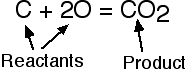
The left side of a balanced equation is called the reactant(s).  The right side is called the product(s).

The number of atoms is determined by multiplying the coefficients and subscripts.

To balance a chemical equation, change only the coefficients.  This changes the number of elements or molecules used or produced without changing the element or molecular configuration itself.

Let’s balance an easy one...

We have 2 H’s on the left, so we need 2 on the right.
And now the 2 Cl’s on the right match the 2 on the left.  We’re in balance.

Here’s one with more steps:


Start with the most complicated configuration, maybe Pb3
on the right.   We need 3 Pb’s on the left.


That gives us 12 Cl’s on the left, so we need the same number on the right.
Now there are 12 Na’s on the right, so we need the same number of Na atoms on the left. 
TIP:  Because the PO4 on the right is held together with parentheses, keep the PO4 on the left as a single entity as well.

And counting up the PO4’s shows that we have 16 on both the left and the right.  We’re in balance.  Notice that we didn’t have to write the coefficient ‘1’ because it is implied.

TIP:  In the balancing act, it is easier to make the final adjustments if there is a reactant that stands alone, a single element.  Try to save these until last.

BALANCING with FRACTIONS


Sometimes when balancing an equation, you'll wind up with terms that can't be split up.  What if you have O2 on one side and O3 on the other?
Assume that O3 is the more complicated entry so we need to get 3 oxygens from the diatomic O2 on the left.  Think of fractions.  We need one and a half O2s or 3/2.

Even though this equation is technically "in balance," most teachers will want you to use only whole numbers as coefficients in chemical equations.  Think about what you would do in a simple Algebra equation to get rid of a fraction.  You'd multiply by a common denominator, so do the same here.  Multiply ALL terms on BOTH SIDES by the denominator 2 to yield

TIP:  The diatomic oxygen is so frequently involved in these fraction situations, that I try to "balance" the oxygens last.  

Although these examples seem simple, the concept itself is simple also, regardless of how complicated a balancing question may appear.  Just remember

MATTER CAN BE NEITHER CREATED NOR DESTROYED.


Sunday, August 11, 2013

SINGAPORE MATH: AT-HOME RESOURCES


WARNING:  THERE IS MORE TO SINGAPORE MATH THAN THE CLASSROOM

Even critics of the Singapore Math program could not object to the proclaimed objectives of teaching students to the mastery level, using real world situations for problem solving, and encouraging communication in math.  After all, these same goals have been recommended by the National Council of Teachers of Math for decades.  Everyone interested in math wants our children to love math, not just tolerate it through 11 or 12 years of compulsory education.

And even the critics may not call enough attention to the need for out-of-school support if students are to achieve that mastery of basic arithmetic concepts.  The Singapore Math classroom curriculum stresses conceptual understanding to the delight of advocates, but procedural and skills proficiencies are often the under-reported secondary requirements that critics demand and that are an integral part of Singapore's education program. 

Unlike the American system in which “school” ends at 2:30 and is replaced by dance class, sports, and other extracurricular activities, in the country which inspired Singapore Math, nearly every student receives supplementary homework assignments, as well as additional rehearsal through math clubs and “after school tuition classes” like our tutoring services.  The reported 1995 (http://nces.ed.gov/pubs99/1999081.pdf) through 2007 (http://nces.ed.gov/timss/table07_1.asp) math success in Singapore may be more heavily dependent on the cultural significance placed on education than we realize.

With this possibility as our hypothesis, effective implementation of Singapore Math in American schools will require at least moderate changes to our priorities.  It will be necessary that after school activities devote more time and effort to the repetitive work -- those dreaded “math facts” like multiplication tables.

Practice in basic computation can be tedious for both parent and student.  Multiple worksheets with 25, 50, 100 problems are boring, to be generous.  A parent verbally making up sample problems is demanding.  The chances are that none of us is going to follow through long enough for our kids to gain the level of skill that we would like.  We need a helper.

Tutoring Resources uses a game we call “War on Integers” which is played like the familiar card game War.  Contact us at www.tutoring-resources.com for a free copy of instructions for playing with addition, subtraction, multiplication, or division.  The game encourages the student to practice in a fun way that doesn’t depend on age or grade level to “win” and promotes the much needed rehearsal.

The internet is another readily available resource.  There are many sites that provide colorful, entertaining games for students from kindergarten through sixth grade and even higher.  My personal favorite (because I played it with my own kids back in the day) is NUMBER MUNCHERS.  I have it on floppy disk (I did mention that it was “back in the day”) but for today’s electronically-literate youth, it’s available for iTunes, iPhone, and iPad Touch.

Other sites to explore include
www.wallofgame.com  (Number Munchers is available on this site.)

www.Sheppardssoftware.com  (A listing of several useful sites.)

www.IXL.com  (This one makes it easy to access appropriate games by grade level and even goes through Algebra.)

www.Cool.math-games.com (This site may not be as distracting for kids who are accustomed to websites as it was for me, but I would not recommend it for anyone with focus and concentration issues.)

As a general rule, games will require dexterity with either arrows or a mouse.  I found them all easier to play on a desktop than laptop computer.

Want more suggestions?  Just search the web for ‘math games’ and be prepared to spend considerable time checking out a myriad of sites that might appeal to the specific interests of your student -- and playing a few yourself.  I lost more than a few minutes on the pop-up www.ahhhhh.com, which is apparently a soft drink website ad, as mezmerizing as it is subliminal.

If our kids are going to get the promised rewards from Singapore Math, parents need to make it a point to provide the supplements that will fill in the gaps.  Luckily, plenty of resources are available to make our job easier.