Friday, August 2, 2013

SINGAPORE MATH: USING BAR MODELS

PARENTS’ GUIDE TO HELPING STUDENTS DRAW BAR MODELS

My mother still laments the transition to “the New Math” in the elementary curriculum between my sister’s experience and my own -- and THAT was 50 years ago!!  It is understandable that parents (and some teachers) are hesitant when something new and radical is implemented in an otherwise comfortably familiar class.

This is the state of affairs in more and more school districts as the educational system searches for ways to improve America’s lack of stellar performance in science, technology, engineering, and math (STEM) programs.  Statistics over the past decade report that very young children in Singapore ranked first in the world in mathematics (Trends in International Mathematics and Science Study (TIMSS)-2003), initiating a wave of interest in the current edition of the newest math experiment, Singapore Math.

I have one suggestion for parents who are feeling unsure of their ability to help their students make the transition to Singapore Math.

                DO NOT PANIC!! 

Although jumping head first into a new method of “thinking math” can seem an impossible challenge, the “Bar Modeling” method used to visualize word problems in Singapore Math is less complicated than it “appears.”  And “appears” is exactly the right term to use because the Bar Method is intended to be a visual collection of details from a word problem.  It is probably most applicable for students who are visually oriented, Visual Learners, but many schools will and are presenting the method to all students, regardless of their learning style.  In the elementary grades, the philosophy is that the very young are not capable of thinking abstractly and require concrete exemplars.  Supporters of Singapore Math profess that the system is a superior way to lead children to a strong foundation for understanding the basics of math.

For parents new to the subject, the “8 Step Approach” proffered by recognized experts on Singapore Math could be helpful if not somewhat cumbersome.  Boiling the process down to a more streamlined form will provide every parent with the basics to competently help with homework.
         1.  Draw a rectangle.
         2.  Divide it into boxes.
         3.  Color in some boxes.
         4.  Divide into smaller boxes.
         5.  Count.

While implementing Singapore Math, think of denominators.  They form the basis for dividing up the BARS.  The process can most easily be described through example.

Lily makes macramé bracelets to sell at the local flee market.  Last weekend, she sold 3/5 of her jewelry on Saturday and 1/4 of the rest of her inventory on Sunday.  If she sold 20 more bracelets on Saturday than she did on Sunday, how many bracelets did she have in the first place.


If 20 bracelets are in the 5 dotted BARS, there are 4 bracelets in each BAR.  We're still using fractional division here. There are now a total of 5 times 2, or 10 bars, each holding 4 bracelets, so there were 40 bracelets at the beginning of the weekend. The division of BARS is relatively simplistic in this example.

Here’s the “traditional” format for writing equations to solve this problem.  It relies on direct translations of the instructions in the word problem to “mathese,” a step that is frequently skipped by students in high school courses, but which can add points on an AP test.

     X = total bracelets
     Saturday Sales = 3/ 5 X
     Sunday Sales = 1/ 4(1 X - 3/ 5 X) = 1/4 (2/ 5 X) = 2/ 20 X
     Saturday Sales = Sunday Sales + 20

         3/ 5 X = 2/ 20 X + 20
         12/ 20 X = 2/ 20 X + 20
         12/ 20 X - 2/ 20 X = 20
         10/ 20 X = 20
         X = 20 (20/ 10) = 40 bracelets


But what about divisions that are more complicated.  A few minor changes in the numbers and dividing the remaining bars seems confusing, but there’s a simple technique.

Lily makes macramé bracelets to sell at the local flee market.  Last weekend, she sold 3/5 of her jewelry on Saturday and 1/3 of the rest of her inventory on Sunday.  If she sold 14 more bracelets on Saturday than she did on Sunday, how many bracelets did she have in the first place.

In the first problem, dividing the remaining BARS was a simple task of dividing each into 2.  This time, instead of dividing into simple fourths, we need to divide the two BARS into three and make similar divisions to Saturday’s sales.  How do you divide 2s into 3s? The least complicated way to create subdivisions is to divide EACH BAR into three pieces.  This process is not unlike finding a common denominator.  Notice that the 2 pieces become 6 smaller parts.


Since there are still 7 dotted BARS in Saturday's group prepresenting 14 bracelets, each new subdivision holds 2 bracelets.  There are now 15 subdivisions in all, so Lily had 30 bracelets to sell at the flee market. 

The traditional solution looks like this:

     X = total bracelets
     Saturday Sales = 3/ 5 X
     Sunday Sales = 1/ 3 (2/ 5 X) = 2/ 15 X
     Saturday Sales = Sunday Sales + 14
         3/ 5 X = 2/ 15 X + 14
         9/ 15 X = 2/ 15 X + 14
         9/ 15 X - 2/ 15 X = 14
         7/ 15 X = 14
         X = 14 (15/ 7) = 30 bracelets to sell in the first place

The problems demonstrated so far are quite complicated and would appear in Singapore Math around the fifth grade level.  If the student started the process earlier in elementary school, the BAR drawings would be a familiar format that may have started with a very, very simple example of adding fractions like this one...

Lily makes lemonade to sell at a booth in her driveway.  She uses all of her ingredients to make lemonade on Saturday and sells 3/5 of her supply on Saturday and 1/3 of the remainder on Sunday. What fraction of the original lemonade was left at the end of the weekend?


Steps:
1.  Divide whole into 5 parts (to
represent the denominator of 3/ 5)

2.  Count out 3 BARS for Saturday.
3.  Divide the remaining BARS into thirds (for 1/ 3 of remaining juice)
4.  Divide Saturday’s BARS similarly.
5.  Mark out 2/6 of Sunday’s subBARS
6.  Mark out the same amount on Saturday (only because it’s become a habit by now, even though it is NOT NECESSARY).
7.  Count the subBARS which have NOT been marked out.

 4/15 of the original lemonade was left over after sales on Sunday.

The traditional solution looks like....

     X = total lemonade
     Saturday Sales = 3/ 5 X
     Sunday Sales = 1/ 3 (2/ 5 X) = 2/ 15 X

     Saturday Sales + Sunday Sales = 3/ 5 X + 2/ 15 X = 11/ 15 X
     Total lemonade - Sales = 1X - 11/ 15 X = 4/ 15 X


IS SINGAPORE MATH WORTH THE HYPE? 

CON:  I’m really not sure whether this method makes fractions easier for students to learn and eventually manipulate.  My own first exposure to fractions was pre-New Math, so I’ve been experimenting with Singapore Math just like everyone else.  At first, CREATING more fractions seems counterintuitive and may cause consternation in the hearts of parents and students.


PRO:  It may be reassuring to parents to find the Singapore approach very similar to one we’ve used for years to teach early elementary numeracy by using cardboard fraction bars (notice the similarity in terminology) or Legos.  In fact, there are commercial Lego kits to use in teaching Singapore Math.  I am certainly delighted to see the attempt to make fractions into friendly things that can be expressed visually for those who think that way, especially since we use rational expressions to great extent in Algebra, Trigonometry, and Calculus.

CON:  Since experts contend that young students are unable to grasp the theoretic concepts, why aren’t they as concerned with those children’s manual dexterity in creating BARS?  The BAR modeling concept relies on  EQUAL divisions.  Consider this potential student drawing:
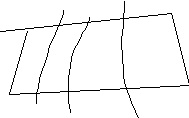
  Is the concept of 1/4 accurately visualized?  Will sloppy drawing confuse the issue of equivalent fractions?


PRO:  I’m in favor of any system which makes collecting and using details from word problems a major focus of study.  Personally, I like “just working problems,” but I haven’t found many students who share the feeling.  The current emphasis in STEM study is the usability of skills, requiring practical applications presented through word problems.  Singapore Math certainly places a premium on word problems and THAT can be a major plus.

CON:  I am not convinced, however, that the time required for accurate artistic renderings is worthwhile in the upper grades.  I’m positive I’d never use the system on a timed test like the ACT.  The statistics which suggest that Singapore’s educational system for teaching math is superior only measures performance at the fourth and eighth grade levels, and at some point, students will have to abandon the visual representations in favor of international conventions. I’m eager to observe how the transition from Singapore Math to traditional solutions will be made.

PRO:  BAR modeling could prove to be a useful key for helping VISUAL LEARNERS to develop an intrinsic understanding of fractions and to translate the details of some word problems.  Singapore Math offers opportunities for revisions that could inspire MANUAL LEARNERS by using clay, for example, and cutting 3-d rectangular prisms into subdivisions.  Innovative teachers might experiment with modifications that are so successful that the next new approach could be called “American Math.”  For the time being, I plan to get as much traction from the latest new system as I can. 


If you find interesting problems from your student's class, please share them in the comments.  
The greater the number of unique examples, 
the deeper the understanding.

Friday, July 26, 2013

FIRST STEP IN CHEMISTRY - The ATOM

 An activity to introduce the atom.

Building an Atom reinforces the concepts of Periodic Table organization, atomic number, atomic mass, proton-electron pairing, shells and subshells, order in which shells and subshells are filled, future study of valence electrons, electron-sharing bonds, ions, and isotopes.


This example represents NEON, element #10, with 10 protons and 10 neutrons in the nucleus, and 10 electrons in the subshells.  The first ring (1s) carries 2 electrons, the second (2s) another 2, and the third (2p) a whopping 6!!


Chemistry isn't normally listed as a discrete subject until high school.  We dabble in it at the lower grades with little activities or "experiments" (Isn't it fun to make bubbles and to see the soda pop erupt from the bottle?), and in middle school we introduce a more scholastic approach to some of the foundational concepts.  But when studied at greater depth in high school, some students get stumped at the very beginning by the Periodic Chart (with all of its imbedded detail), the structure of the atom (which seems more like fiction than fact since we never actually "see" it with our own eyes), and the confounding electron cloud. 

At Tutoring Resources, the Summer Preview in Chemistry recognizes the seemingly abstract aspect of the subject and employs ways for a variety of students to gain an intrinsic understanding by doing activities that may not be possible in a classroom of 30 kids.  This year, we've expanded the program to middle school students with great success, proving once again that younger students can rise to the challenges of higher level learning.

This blog explains an activity to explore the structure of the atom through arts and crafts.  It can be completed at home with some basic craft supplies.

Supplies you'll need:
     -- wire rings, embroidery hoops, or thick wire to simulate the subshells.  Each successive shell should be of larger diameter than the previous one.
     -- styrofoam balls, wooden balls, beads, or similar objects to represent protons, electrons, and neutrons, each component of a different color to differentiate them.
     -- paint, to achieve different colors.  Use a paintbrush, not spray paint on styrofoam.  I've had the unfortunate experience of spray paint melting styrofoam.  Although this may be an interesting reaction in a chemistry experiment, physical and chemical changes come much later in the curriculum.
     -- glue or glue gun to affix the components in place.  The younger the student, the less advisable is a hot glue gun!!  I've had strapping football players react strongly to hot glue on fingers.  I've also seen a clear plastic ornament used for the nucleus -- quite attractive and allows the protons and neutrons to move around inside.
     -- string, fishing line, or thread to tie the rings together, attach the nucleus at the center of the innermost ring, and hang the "atom" for display.
     -- a periodic chart for guidance.

Building several "atoms" has pinpointed a few tips that make the construction easier and more effective.
     §  Make the nucleus first by gluing "protons" and "neutrons" together in sort of a sphere.  Before adding the last few components, glue in the string that will be used to tie the nucleus to the shells.
     §  Tie the appropriate number of rings together using the scouting method for connecting teepee poles.  This will help to spread the rings for a more spherical presentation.
     §  I tried sawing an opening in the metal rings so the styrofoam balls could be strung on, but that was a lot of effort.  I settled on cutting a slit in the styrofoam and pressing each one onto the ring.  A squirt of glue closes the slit and keeps the balls from sliding to the bottom.
     §  When cutting a length of string for tying, longer is better.  It's easier to cut off excess thread than it is to tie a square knot with only an inch to work with.
     §  A dab of glue is an effective method of setting a knot, especially in fragile threads.

STEPS:
1.  Decide the element to be constructed.*
2.  Determine the number of protons, neutrons, and electrons needed.
3.  Assemble materials.  Paint components if necessary.
4.  Construct nucleus.
5.  Tie rings together.
6.  Tie nucleus so it hangs in the center of the innermost ring.
7.  Affix electrons to appropriate rings.
8.  Tie string as a hanger and suspend far enough from a wall to allow the "atom" to move with the breezes.

* To make the exercise more challenging, I prepared a few styrofoam balls in three different colors.  The students needed to count how many of each color were available and then select an element that would need no more components than they had at their disposal.  This approach reinforced the idea of protons and electrons being equal and the value of an element's atomic number.

Did the activity work?  Well, from the social media posts, the enthusiasm of requests to "make another one," and the fluency with which the kids can now speak the names of  the first 10 elements, I think atom building will be a feature of the Chemistry Preview for many years to come.


Atom display: (L to R) Neon, Helium, Lithium, Hydrogen, Boron


EXTENSIONS:  The concepts introduced here can be expanded to introduce Periodic Table BLOCKS, electron configuration, elements with higher atomic numbers, isotopes, and ions.

An anecdote from the experience of a seventh grader:  In working on the valance shell, the student dropped one of the electrons and questioned what had happened to the element.  This became a learning opportunity to introduce ions.

Sunday, July 21, 2013

QUICK STEPS TO COMPLETE THE SQUARE

This article is going to be a “quickie” because I believe Completing the Square should be just that....quick, easy.  So let’s dispose of all the middle steps and just move swiftly from the General Quadratic Equation to the Vertex Form.

We’ll use a sample equation.......12X^2 + 8X - 10 = Y

1.  Start with the pattern
     of the Vertex Form.................................A(x + h)^2 + K = Y

2.  From the original equation,
     think of the X-variable
     terms as a separate entity......(12X^2 + 8X) - 10 = Y

3.  Factor out the leading
     coefficient, so that the
     coefficient on the X^2
     is just 1..............................12(X^2 + 8/12 X) - 10 = Y

     I’d reduce that improper
     fraction...............................12(X^2 + 2/3 X) - 10 = Y

4.  Fill in “A” in the
     Vertex Form..........................................12(X + h)^2 + K = Y

5.  Fill in the “h” value
     of the Vertex Form
     with 1/2 the new
     coefficient on X in
     Step 3..............................................12(X + 2/6)^2 + K = Y

     I like smaller numbers, so I’m reducing
     that pesky improper fraction................12(X + 1/3)^2 + K = Y

6.  Think for a second about what we’ve
     done.  By creating the (X + h) binomial
     and squaring it, we’ve actually added
     more to the equation.  (FOIL it through
     if you need proof.)  So we need to
     remove it again.

     Square “h”, multiply it by “A”,
     and subtract it from the
     constant in the General
     Form equation...................12(X + 1/3)^2 + (- 10 - 12/9) = Y

     I feel I’m doing more reducing that any
     real work here.....................12(X + 1/3)^2 + (- 10 - 4/3) = Y

7.  A little arithmetic and,
     TAH-DAH, I’m ready
     to solve for X and label
     the vertex on a graph......................12(X + 1/3)^2 - 34/3 = Y


Many texts add the step of finding the perfect square trinomial before factoring it into the binomial squared.  I think it’s just a way to insure that you subtract out the extraneous constant value but I prefer "the elegant solution."

ALGEBRA II: QUADRATIC EQUATIONS AND THE PARABOLA

EVERYTHING YOU NEED TO KNOW ABOUT
QUADRATIC EQUATIONS AND THE PARABOLA
 IN THE ALGEBRA II CURRICULUM

Quadratic equations can be expressed in several forms, each emphasizing a different aspect of graphs.  In Algebra I we learned the General Form and practiced factoring, substituting various values of X or Y, the Quadratic Formula, and (maybe) Completing the Square.  In advanced Algebra courses, we manipulate the General Form to openly express some of the familiar coordinates (like the vertex) and to examine in greater depth some of the properties of the Parabola.

While what follows are simple explanations of a Parabola that opens up, a few transformations will describe graphs which open down, right, or left.  If more detail on transformations is needed for your class, use the comments section to request examples.

   
    GENERAL EQUATION FORM            AX^2 + BX + C = Y

    VERTEX FORM                                  a (X-h)^2 -k = Y

    STANDARD FORM                             X^2 = 4PY
                                                               (X-h)^2 = 4P (Y-k)

-------------------------------------------------------------------------

GENERAL FORM


        AX^2 + BX + C = Y

    This is the form that is used in systems of equations and matrices.

    Coefficients from the General Form are also used in the quadratic formula to find X intercepts.


    These X values give the intercepts of the X axis -- the roots.
  
    The X value of the Vertex is the midpoint between the two roots.  Substitute to find the Y coordinate of the Vertex.

    The axis of symmetry is .... X = the X value of the vertex.

    The Y intercept is C.

Graphing from the General Form


    Factoring or solving for the root is generally the first step in graphing from the General Form.  And, of course, the y-intercept is expressly given as the constant.

    Finding the vertex takes a little more calculation.


                            X^2 - 10X + 21 = Y


X = 7, 3

Vertex X = 5
Vertex Y = -4

Y intercept = 21


VERTEX FORM


        a (x-h)^2 - k = y

    In this form, (h,k) is the vertex of the parabola; hence the name “vertex form.” 

    To move from the General Form to the Vertex Form, you will need to complete the square.  (See the blog, Quick Steps to Completing the Square, 7-22-13)

    To find the roots (solutions), solve for X by isolating the (x-h)^2, taking the square root of both sides, and isolating  X.

    The y intercept is calculated by substituting 0 (zero) for X.
  

Graphing from the Vertex Form


    As the name implies, the vertex is the first step in graphing from this form.  Calculations are needed to find the axis intercepts.


a (x-h)^2 -k = y

Vertex = (5, -4)

X intercepts = (7,0) and (3,0)

Y intercept = 21


Did you notice that the same 4 points are used to graph from both the General and Vertex Forms?  If a fifth point is required for class, use the symmetry principle to find the point directly across from the y-intercept and the same distance from the axis of symmetry but on the other side.


STANDARD FORM


        X^2 = 4PY

        (x-h)^2 = 4P (y-k)

    This form emphasizes the Focus and Directrix of the graph.  (h,k) is the vertex and P is the distance from the vertex to the Focus point along the axis of symmetry (X = Vertex X) and the distance from the Vertex to the Directrix.  The Directrix is the horizontal line, Y = Vertex Y - P.

    To solve for the roots, substitute 0 (zero) for Y.

    To solve for the Y intercept, substitute 0 (zero) for X.

Graphing from the Standard Form


    Details represented in this form are especially useful in physics.  The focus is the point to which any ray striking the ‘”cup” of the parabola is reflected.

(X - 5)^2 = 1(Y + 4)
     4P = 1
       P = 1/4

Vertex = (5, -4)
Focus = (5, -15/4)
Directrix, Y = -17/4
X intercepts = (3,0), (7,0)
Y intercept = (0,21)


Do you notice anything “special” about the Standard Form compared with the Vertex Form?  They are actually the same, but the Standard Form specifically mentions the 4P value.  A little algebra and you’ll see that  4P = 1/ a.  All we’ve really done is isolate the squared binomial by moving everything else to the other side of the equation.

Any of these equations can describe a Parabola opening down by changing P to the Arithmetic Inverse or a Parabola opening left or right by exchanging X with Y and vice versa. 


Relation of the Focus, Directrix, and Latus Rectum*


    Any point on the Parabola is equidistant from the Focus and the Directrix; that’s the definition of the Parabola, and the distance is explicitely expressed in the Standard Form as P.  The Latus Rectum is the length of a line perpendicular to the Axis of Symmetry, through the focus, and intersecting the curve of the Parabola.  It is also directly expressed in the Standard Form as 4P.

    *  Please excuse a little silliness in the middle of all this serious math.  I work with Middle Schoolers quite a bit and, although many schools exclude it from the curriculum, mention of the “Latus RECTUM” always brings a giggle, something that is too often missing in the math classroom.

Friday, June 28, 2013

TRIG SUM AND DIFFERENCE IDENTITIES

THE RHYTHM OF TRIG SUM & DIFFERENCE IDENTITIES

               Sin (A + B) = Sin A Cos B + Cos A Sin B
               Sin (A - B) = Sin A Cos B - Cos A Sin B
               Cos (A + B) = Cos A Cos B - Sin A Sin B
               Cos (A - B) = Cos A Cos B + Sin A Sin B
               Tan (A + B) =   Tan A + Tan B 
                                      1 - Tan A Tan B
               Tan (A - B) =   Tan A - Tan B 
                                      1 + Tan A Tan B

It’s no surprise to find a teenager listening to music while studying.  There are two ways to recognize a familiar tune: the notes and the rhythm.  Try it. 

Play the notes and try to identify the song:


Did you recognize Mary Had a Little Lamb?  Even without the quarter notes, half notes, and measures, you would still know the tune.

Try this one with just the pacing:


 The "merrily, merrily, merrily, merrily" probably gave away that this one is Row-Row-Row Your Boat.  If you recognized it, try using rhythm to remember the Trig Sum and Difference Identities.

First, establish the pattern of syllables.  Then clap or tap the syllables for each word.

     Sin (A +/- B) = Sin A Cos B +/- Cos A Sin B

Read this as    SINE  COSINE      COSINE       SIN
Tap it out as    CLAP  CLAP-CLAP CLAP-CLAP CLAP

Once you know the rhythm you can write out sin and cos, fill in the A’s, B’s, and plus or minus symbols. 

     Cos (A +/- B) = Cos A Cos B -/+ Sin A Sin B

    Read as          COSINE        COSINE         SINE     SINE
    Tap it out as     CLAP-CLAP   CLAP-CLAP    CLAP    CLAP

    and fill in the angles and minus or plus.

Notice with these two identities, Sine sum or difference start with ‘sine’ and Cosine sum or difference start with ‘cosine’.  In addition, the Sine formulas have the same sign (+ or -) as the computation of the angles, while Cosines are opposite.

     Tan (A +/- B) =    Tan A +/- Tan B
                               1 -/+ Tan A Tan B


    Read as           TAN      TAN       ONE  TANTAN
    Tap it out as      CLAP   CLAP     CLAP-CLAP-CLAP

When filling in operations, notice that Tangent is Sine over Cosine, so the numerator maintains the operation on the angles but the denominator uses the opposites.

Once you know these identities, you won't have to learn the Double Angle Identities because you could just substitute (A + A) for (A + B). Each Sum and Difference equation can do double duty.  And who wouldn't like the requirement to learn half as much?!?

----------------------------------------------------------------------------

PRACTICE

These exercises obviously take liberties with musical notations, but tap out the rhythms and use an unexpectedl part of your brain to remember the Sum and Difference Identities.


TANGENT:
Tan Tan OneTanTan


SINE:
Sine Cosine Cosine Sine


COSINE: Cosine Cosine Sine Sine


Thursday, June 27, 2013

PARTIAL FRACTIONS, the basics

WHY DO WE STUDY PARTIAL FRACTIONS IN ALGEBRA AND PRECALCULUS?

In the early days of Algebra study, we covered “collect like terms” so that the process would be a simple step once we got to FOIL (also called “double distributive” in some schools).  The same thinking encourages us to learn other basic algebraic steps before using them in more complicated mathematics.  In Calculus, we may need to decompose rational expressions before applying the rules of integration.  By doing the initial algebraic work of decomposition now, higher level concepts will be easier to learn and understand.

There are several situations which may be presented in Partial Fraction exercises.  We’ll start with the simple and work toward the more complex.

Simple rational expression:

                2x + 3      
          (x^2 - 7x +10)        Notice that the degree of the numerator is smaller than the degree of the denominator.  This is an important restriction that must be met.  (see below: “What if the Numerator is a higher degree than the Denominator?”)

    STEP 1 - factor the denominator

              2x + 3  
            (x-2)(x-5)

    STEP 2 - using the factors from the denominator, list separate fractions to form an equation. (We don’t know the numerators yet, so let’s just keep them blank until Step 3).

              2x + 3         ?         ?  
            (x-2)(x-5)= (x-2) + (x-5)

    STEP 3 - Substitute letters for the unknown numerators.

              2x + 3         A         B  
            (x-2)(x-5) = (x-2) + (x-5)

    STEP 4 - Expand the right side to have a common denominator.

              2x + 3       A(x-5) + B(x-2)
            (x-2)(x-5) =      (x-2)(x-5)

    STEP 5 - Since denominators on both sides of the equation are the same, set the numerators equal and distribute A and B.
   
              2x + 3    =  Ax - A5 + Bx - 2B

    STEP 6 - Collect like variable terms.

              2x + 3   = (A + B)x - 5A - 2B

    STEP 7 - Create a system of equations by setting coefficients of the variables equal.

            2  = A + B
            3  = -5A -2B 
The reason I prefer this ‘systems’ method to some others is that I can use the matrix function on my calculator to get answers with only a few key strokes and no manual arithmetic.

    STEP 8 - Solve the system.

            A = -7/3
            B = 13/3

    STEP 9 - Seems like a lot of steps so far, but this is the last one.  Substitute A and B values into the equation from Step 3.

              2x + 3         -7/3      13/3 
            (x-2)(x-5) =  (x-2) +  (x-5)


WHAT ABOUT MORE COMPLEX DENOMINATORS?             
  
More factors?  Include more fractions in Step 3....
   
                 2x + 3                           
            (x-2)(x-5)(x-1) = (x-2) + (x-5) + (x-1)

    .... and continue with Steps 4 - 9  (SOLUTION:  A = -7/3, B= 13/12, C= 5/4)

Repeated binomial factors?  Consider the highest degree of the repeated binomial and EVERY SMALLER DEGREE to set up the equation in Step 3....

                2x + 3                    B           C    
            (x-2)(x-5)^2   = (x-2) + (x-5) + (x-5)^2

    ....and continue with Steps 4 - 9.  (SOLUTION:  A= 7/9, B= -7/9, C=13/3)

A quadratic factor?  If the denominator is quadratic, make the numerator of the fraction a binomial...

          2x + 3             A        Bx + C   
    (x-2)(x^2 - 5)   = (x-2) + (x^2 - 5)

    ....and continue with Steps 4 - 9.  (SOLUTION: A=-7, B=7, C=16)

 What if the Numerator is a higher degree than the Denominator? 
AHA!!  Another example of how simple algebra concepts are eventually used again as steps within more complex algorithms!!  To satisfy the requirement that Partial Fractions can only be constructed if the Numerator is a lower degree than the Denominator, we need to break up the rational expression even more by LONG DIVISION.  The Partial Fraction is constructed from the REMAINDER, expressed as a fraction with the divisor as the Denominator.

Wednesday, June 26, 2013

VECTORS IN A NUTSHELL


WHY SHOULD I LEARN ABOUT VECTORS?

After so many years of working with the same curriculum, I sometimes need to be convinced of the benefit of learning something new.  I’m relatively sure many students feel the same way.  So when it came time to expand the curriculum to include vectors, I was resistant.  However, a little research pointed out that many of my interests could benefit from understanding vectors.

Of course, vectors are found in science and engineering, but those disciplines have never prompted me to learn vectors in the past.  A math class problem made me realize that the football quarterback is thinking in vectors when calculating where to throw the ball and how much force to use to get it to the intended receiver.  In my youth, I thought of being a weather forecaster, and now I discover that vectors are needed to draw wind maps.  Fats Domino, famous pool player, was expert in calculating vectors to “drop the 5 ball in the corner pocket” by first hitting it with the 10 ball.  In helping a student study for the police exam, I found that investigators use vectors to describe the details of an accident.

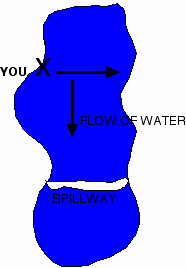
Our trigonometric experience with triangles is useful in determining the outcome of opposing forces described as vectors.  For example, you want to swim across the Rock River.  There's a spillway about 100 yards downstream from where you are.  Considering the rate at which the water is flowing, can you swim to the other side before falling over the spillway and possibly incurring bodily harm? We never thought about this when we, as teens, were swimming across the river, but maybe we should have.

Wow, maybe vectors ARE worth learning to prepare for a wide variety of experiences and careers.  So let’s get started...

WHAT IS A VECTOR?

In its most general description, a vector is a line which demonstrates 2 characteristics:
                LENGTH (called "magnitude")
                and
                DIRECTION, indicated by an arrow head at its terminal end

Here's a vector drawn on the coordinate plane:

It starts a S(1,2) and ends at T(6,5).

To find the Cartesian coordinates that would name this vector if it started at (0,0), we would subtract:
                   T - S
and, in this example,  get  (5,3).  From these coordinates, we can calculate the MAGNITUDE by using the Pythagorean Theorem:

                  magnitude, ||ST|| = √ (x^2 + y^2) = √ (5^2 + 3^2) = √( 34)

           Finding ||ST|| from the original components is just like the distance formula:
                                       ||ST|| = √[(6-1)^2 + (5-2)^2]

The coordinates also give us all the information necessary to determine the angle, or direction, of the vector:

                  Tan θ = y/x     or the longer way Tan θ = (5-2)/(6-1)
                                      Doesn’t that fraction look just like SLOPE?  


When the magnitude and direction are given as polar coordinates, (r, θ)....
....the x and y coordinates can be calculated using these equations:
              x = r(cos θ)
              y = r(sin θ)    (Remember from Trig....Cosine is the x axis, Sine is the y axis) 

COMPUTATIONS WITH VECTORS

ADDITION

Let Vector A = (3,8)
      Vector B = (2,4)

To add Vector A and Vector B for a RESULTANT Vector C:

    Add the x values.........3 + 2 = 5
    Add the y values.........8 + 4 = 12

The RESULTANT Vector C = (5,12)
with magnitude of 13.


SUBTRACTION

To subtract Vector B from Vector A for a RESULTANT Vector D:
  
     Subtract the x values.....3 - 2 = 1
     Subtract the y values.....8 - 4 = 4...........Vector D = (1,4) with magnitude of √17

SCALAR MULTIPLICATION

To increase a Vector by a given scale, multiply both x and y by the scale.

     5(Vector A) = 5(3,8) = (15,40)

DOT PRODUCT versus CROSS PRODUCT

DOT PRODUCT (sometimes called the SCALAR PRODUCT or INNER PRODUCT) is found by multiplying the x values together and the y values together and adding the two products.  The answer is a single number.

     Vector A (3,8) • Vector B (2,4) = (3)(2) + (8)(4) = 6 + 32 = 38

If the sum equals 0, the two lines are PERPENDICULAR.  WHY?!?
    Well, let's look at what we know from Algebra I.  If the slopes of two lines are opposite inverses, then the lines are perpendicular.  So, multiplying (as in the Dot Product) the numerator of two perpendicular slopes would be the additive inverse (opposite) of the product of the denominators.  Adding the two would result in a sum of zero.....ergo perpendicular lines. 

CROSS PRODUCT (sometimes called the OUTER PRODUCT)

     (Vector A) X (Vector B) = ||A||•||B||

Although Cross Product will not appear until later in the program, it is important to recognize the differences now, when we're talking about the Dot Product.  Dot Product can be completed on two vectors in a single plane; the Cross Product is only applicable in 3 dimensions.  It provides a vector perpendicular to two other vectors in a plane -- a vector perpendicular to that plane.  Cross Product involves matrices, so brush up on Cramer's Rule and determinants before we get to it later in the curriculum.

OTHER UPCOMING ISSUES WITH VECTORS 

Once we're comfortable with these basic vector concepts, we can explore more complex issues like unit vectors, resolving vectors into their components, vectors in 3 dimensions, and representing scalar values of unit vectors using i, j, and k.